Brasserie and bistro get used as though they are interchangeable words for “casual French restaurant”. They are not. They describe two different institutions with different origins, different hours and, most usefully for anyone deciding where to eat, different drinks.
The short answer
A brasserie is a large, informal room built around beer, open continuously from morning until late, with a long menu that stays the same. A bistro is small, built around wine, open for lunch and dinner with a break between, and works from a short menu that changes with what was bought that day.
Size, hours, drink and menu length. Those four things will tell you which one you are sitting in.
The words themselves
Brasserie is the straightforward one: it is French for brewery, from brasser, to brew. The rooms were beer halls first and restaurants second, which is why beer still leads. The Centre National de Ressources Textuelles et Lexicales records both senses of the word — the brewery and the eating house — still in active use.
Bistro has a murkier history. The popular story that it comes from Russian soldiers shouting bystro — “quickly” — in 1814 Paris is almost certainly a later invention; the word does not appear in print until decades afterwards. What is not in doubt is what it came to mean: a small, cheap, family-run place serving a handful of dishes.
The differences that actually matter
| Brasserie | Bistro | |
|---|---|---|
| Origin of the word | French for brewery, from brasser, to brew | Uncertain; recorded in Paris in the late 1800s |
| Size and room | Large, high-ceilinged, often loud, with a full bar | Small, cramped, quiet, often no bar |
| Drink focus | Beer first | Wine first |
| Hours | Continuous, morning until late | Lunch and dinner, closed in between |
| Menu | Long and unchanging | Short and frequently changing |
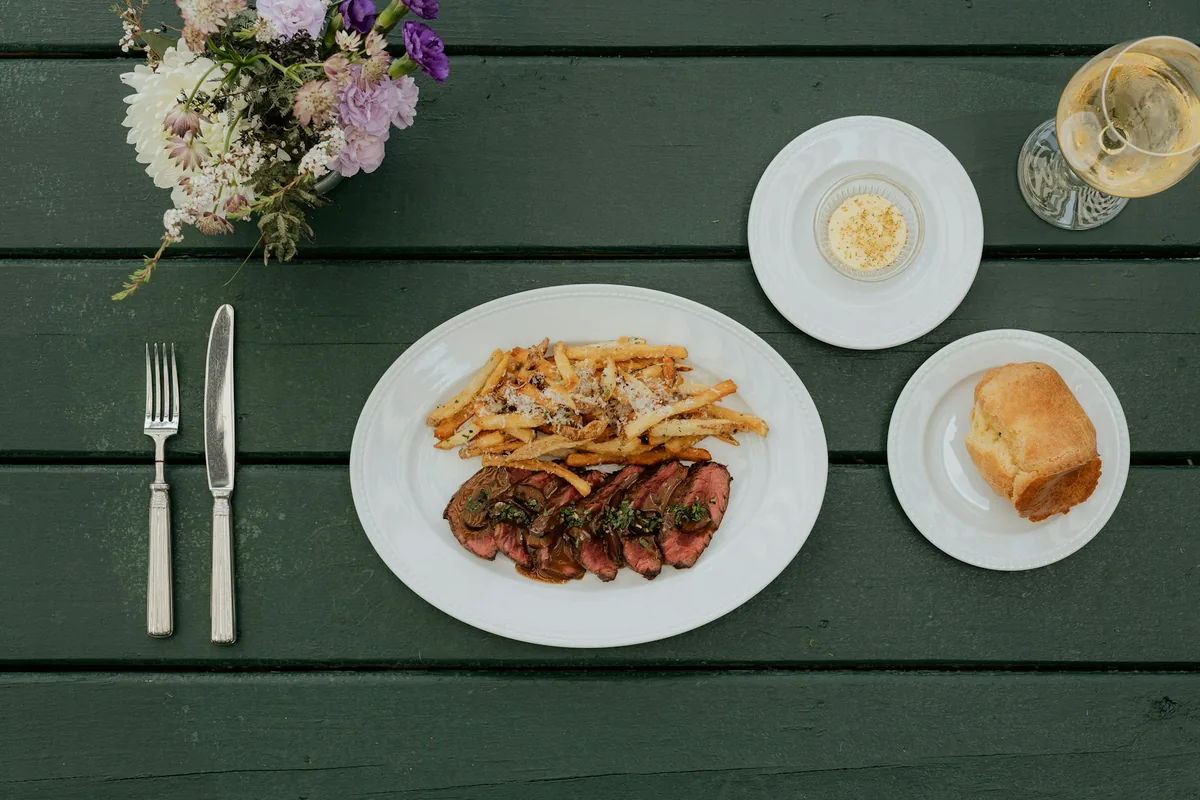
| Typical dishes | Steak frites, choucroute, mussels and frites | Whatever was bought that morning |
| Best for | Groups, odd hours, a long sit | Two people, a set mealtime, a bottle of wine |
Hours are the practical test
If it is three in the afternoon and the kitchen is open, you are in a brasserie. Bistros traditionally close between lunch and dinner. This is the single most reliable difference and the one most likely to affect your day.
The drink tells you the priority
A brasserie has a proper bar and a serious beer list. A bistro has a wine list, often short and often regional, and may not have a bar at all. Everything else about the two formats follows from this.
Menu length signals the kitchen
Brasserie menus are long and stable — the same dishes, reliably, for years. Bistro menus are short and move, sometimes written on a board because they change too often to print. Neither is better. They are solving different problems.
The other two words: café and bouillon
Brasserie and bistro are the pair people ask about, but they sit in a set of four, and the other two are what cause most of the remaining confusion.
Café
A café is built around drinks. Coffee in the morning, wine and beer later, and food as a secondary offer — a sandwich, a croque monsieur, a single plat du jour chalked up at lunch. The kitchen is small or nonexistent. If the room is dominated by a counter and most people at the tables have a drink and nothing else, it is a café.
In Belgium the café tradition runs deep and overlaps heavily with beer. A Belgian brown café will have a beer list to rival a brasserie’s and almost nothing to eat, which is the reverse of what visitors expect.
Bouillon
The rarest of the four and the most specific. Bouillons were nineteenth-century Parisian canteens set up to feed workers cheaply and quickly — enormous rooms, very short menus, very low prices, broth as the founding dish. Most closed. The handful that survive are now protected historic interiors and trade largely on that.
If a place calls itself a bouillon today, expect a grand belle époque dining room, traditional French dishes and prices that are still unusually low for the setting.
Where Belgium complicates it
Almost everything written about brasseries and bistros treats both as French. Belgium kept the brasserie and made it more so: a deeper beer list, a specific glass for each beer, mussels and frites rather than steak frites, and croquettes with the first round.
A Belgian brasserie is therefore further from a bistro than a French brasserie is. The wine-versus-beer split, which is a tendency in France, is close to absolute in Belgium.
Our guide to what a Belgian brasserie is covers that version of the format in detail, including why the same word also names Belgian breweries.
Which should you choose?
Pick a brasserie when you want to eat at an awkward hour, when you are with a group of more than four, when you want beer with dinner, or when you want to sit for a long time without being turned over.
Pick a bistro when you want a short, seasonal menu, a bottle of wine and a quieter room, and when you are eating at a conventional mealtime.
Neither is smarter than the other. The bistro’s reputation for being the more serious food destination is a recent invention — both grew out of feeding working people cheaply.
Frequently asked questions
Is a brasserie more expensive than a bistro?
Not inherently. Both began as inexpensive, everyday places. Price today depends far more on the individual restaurant and its neighbourhood than on which of the two words is above the door.
Is a bistro the same as a café?
No. A café is built around drinks — coffee, wine, beer — with food as a secondary offer, often just sandwiches and a plat du jour. A bistro is a restaurant that happens to be small and informal.
Which one is better for a group?
A brasserie, almost always. Bistros are small by definition and rarely have the tables for more than four. A brasserie is built for volume and will usually take a walk-in party without complaint.
Do brasseries take reservations?
Many do, but the format is designed for walk-ins. The long hours and large dining rooms exist precisely so that turning up unannounced usually works.
What food is a brasserie known for?
In France, steak frites, choucroute and shellfish. In Belgium, mussels with frites, croquettes, and waffles. Both keep the same dishes on the menu year-round.
The short version
Brasserie: big, beer, all day, long menu. Bistro: small, wine, mealtimes, short menu. The words are not decorative — they tell you what the room was built to do.
If you want to see how the Belgian version of the format worked in practice, the archived Meyboom menus show a brasserie menu in full: long, stable, and organised around the beer list.