
Order a beer in Belgium and it arrives in a glass made for that beer and no other — the right shape, the right size, the brewery’s name on the side. Order the same beer somewhere that has run out of the correct glass and you may be told, politely, that they cannot serve it.
The short answer
Belgian beers are served in their own glasses because the shape genuinely changes the drink: it controls how much foam forms and survives, how much aroma reaches your nose, and how quickly the beer warms in your hand. Belgian brewers design a glass alongside the beer, and Belgian bars treat serving it in anything else as serving it wrong.
What the shape is actually doing
Aroma
Belgian yeast produces a lot of aromatic compounds — pepper, clove, banana, orange. A glass that narrows towards the rim concentrates those volatiles above the surface so they reach you as you drink. A straight-sided pint lets them escape sideways. With a tripel, this is the difference between tasting the beer and merely drinking it.
Foam
Belgian beer is meant to hold a dense head, and the head is not decoration. It traps aroma and slows oxidation. Glasses are shaped, and often etched at the base, to keep a steady stream of bubbles feeding the foam from below.
Strength and pacing
A 9% tripel is not served in a pint glass because it should not be drunk in pint measures. The chalice and goblet used for strong Trappist ales hold a modest pour, which is a serving decision as much as a design one.
Temperature
Stemmed glasses exist so your hand is not wrapped around the beer. Strong Belgian ales are served around cellar temperature and warm quickly.
The main glass shapes
| Glass | Shape | What it is for | Typical styles |
|---|---|---|---|
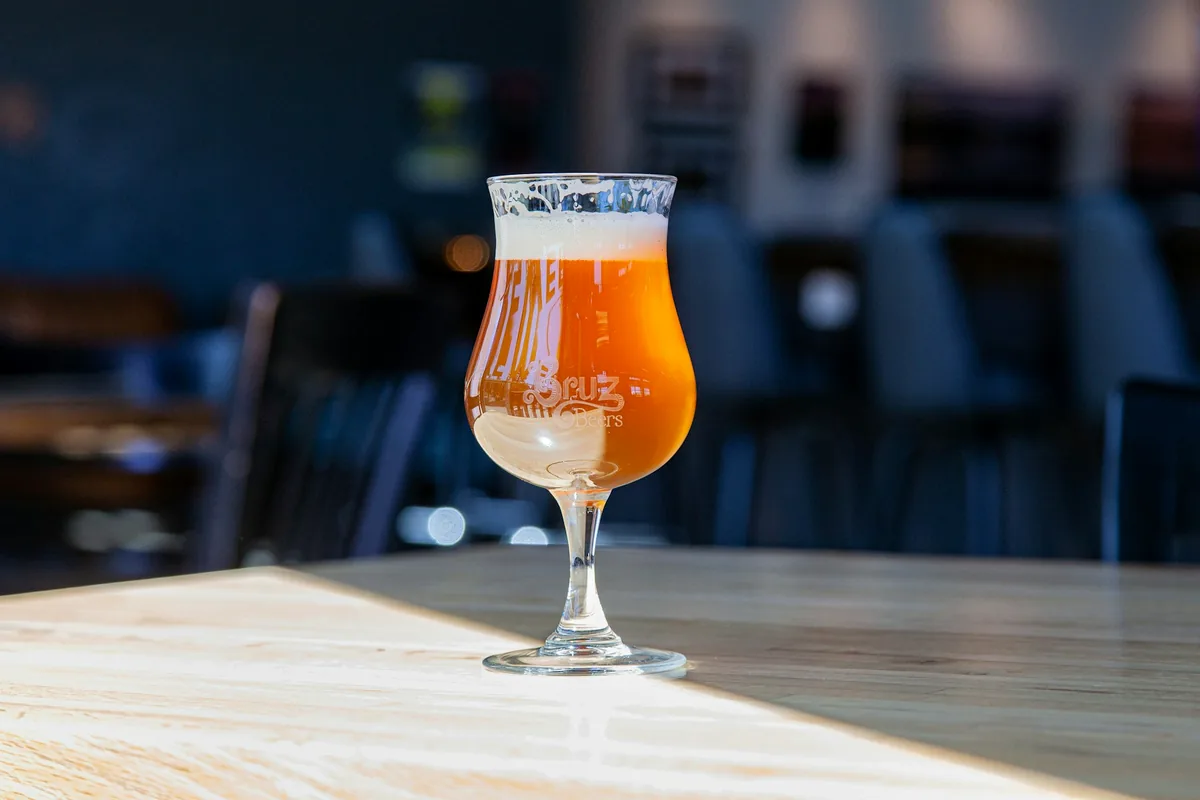
| Tulip | Bulbous body, flared rim, stemmed | Concentrates aroma and supports a big head | Golden strong ale, tripel |
| Chalice or goblet | Wide, heavy bowl on a thick stem, often etched | A modest pour of a strong beer, kept off the hand | Dubbel, quadrupel, Trappist ales |
| Witbier tumbler | Thick, straight-sided hexagon | Holds the chill and shows the cloudiness | Witbier |
| Flute | Tall and narrow | Preserves carbonation and shows colour | Fruit lambic, kriek, framboise |
| Kwak glass | Rounded base in a wooden stand | Cannot stand alone; bulb holds aroma | Kwak, and nothing else |
The Kwak glass, and why it has a stand
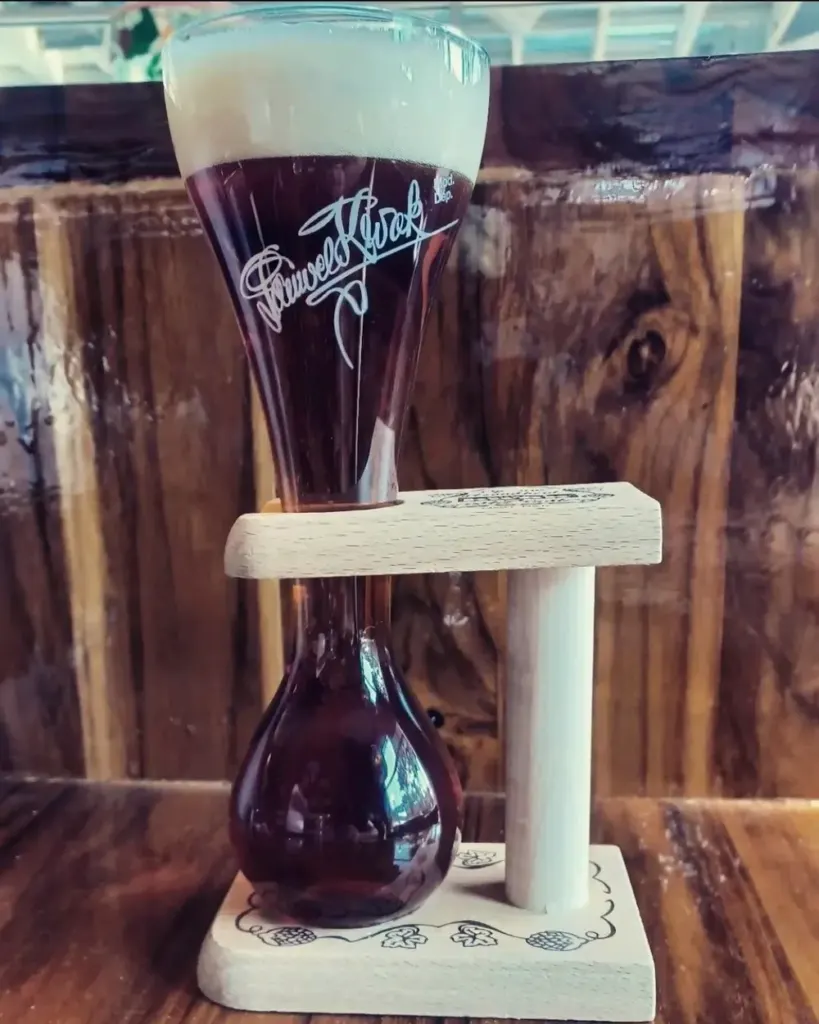
The most conspicuous glass in Belgian brewing is Pauwel Kwak’s: a long, rounded-bottomed vessel that cannot stand up on its own and comes clamped in a turned wooden holder.
The story attached to it is that Pauwel Kwak ran a coaching inn around the start of the nineteenth century, and that coachmen were not permitted to leave their carriages to drink. The glass, in its wooden stand, could be hung from the coach — designed to be held in a gloved hand and stowed rather than set down.
How much of that is history and how much is good marketing is genuinely unclear, and it is worth saying so. What is not in doubt is the effect: the bulb at the base holds the aroma, and the wide mouth delivers it. Meyboom Brasserie carried Kwak on its bottle list, and also sold it as a four-pack with the glass included, which is the usual way people end up owning one.
The pour matters as much as the glass
A correct glass poured badly gives you nothing, and the Belgian method is different from the one most people use.
- Start with a clean, dry, room-temperature glass. A wet or greasy glass kills the head instantly, which is why Belgian bars rinse and drain rather than pulling glasses straight from a chiller.
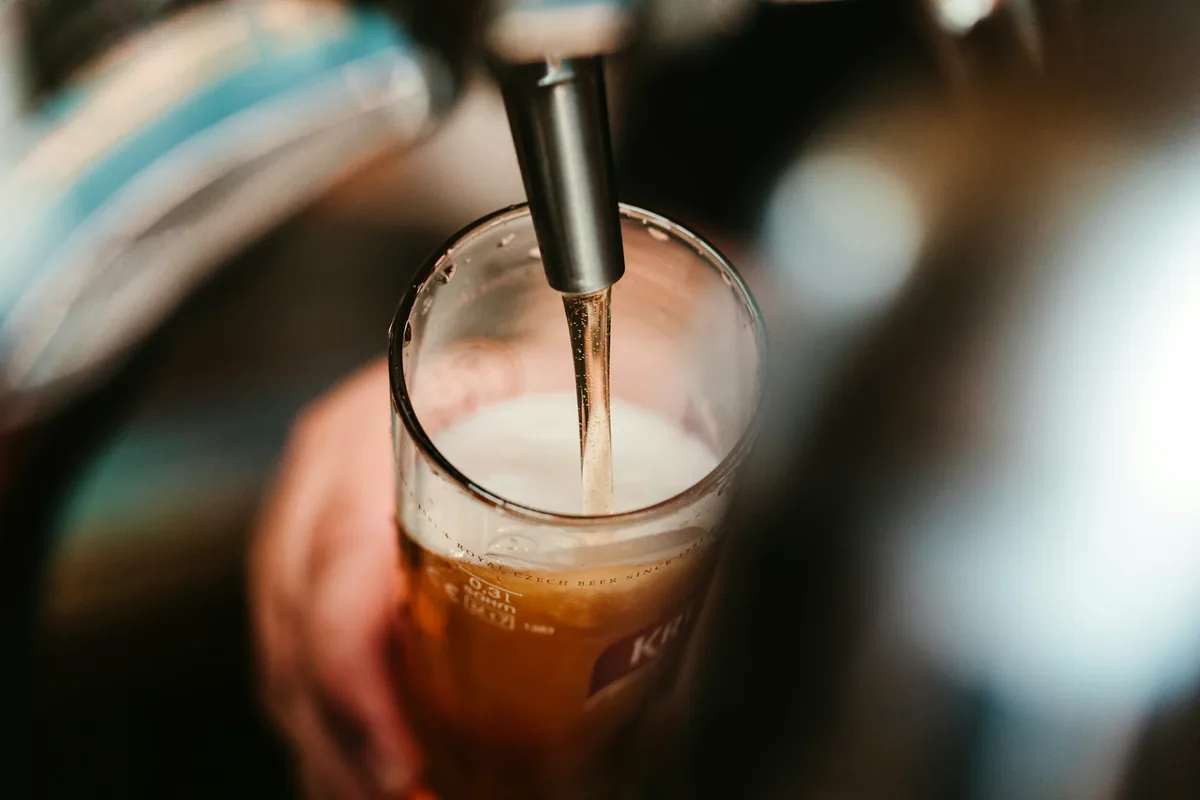
- Pour down the middle, not the side. This is the part that surprises people. Tilting the glass and pouring down the wall is standard for a lager; for a Belgian ale you want the beer to break on the bottom and throw a substantial head.
- Let it settle, then top up. Two or three stages rather than one continuous pour.
- Leave the yeast behind if the bottle is refermented. Many Belgian bottles carry a yeast sediment. Pour steadily in one movement and stop before it slides in — or pour it in deliberately, if you like the extra body. Both are defensible; what you should not do is disturb it halfway.
- Skim if you need to. A flat knife across the rim to take the top off an over-enthusiastic head is normal practice, not a failure.
The result should be a head of two or three centimetres that lasts to the bottom of the glass and leaves rings of lace on the way down.
Is any of this snobbery?
Some of it, plainly. The branded glass is also a marketing instrument, and no brewery objects to its name being on the table.
But the functional part is real and easy to test: pour the same strong ale into a chalice and a straight pint glass and smell both. The difference is not subtle. Belgian beer culture as a whole is recognised by UNESCO as intangible cultural heritage, and the glassware convention is part of what that recognition describes — a set of practices around brewing and serving, not just the liquid.
Frequently asked questions
Why do Belgian bars refuse to serve a beer without the right glass?
Partly service standards and partly contract — breweries supply glassware and expect it to be used. The practical reason is that the wrong glass measurably changes head retention and aroma, so the bar is not serving the beer the brewer designed.
What is the etched circle at the bottom of a beer glass?
A nucleation point. The roughened surface gives dissolved carbon dioxide somewhere to form bubbles, which keeps a stream rising through the beer and continually rebuilds the head.
Why is the Kwak glass shaped like that?
It is a coachman’s glass, or at least that is the tradition: rounded at the base so it could sit in a holder on a carriage, and wide at the mouth. The stand exists because the glass cannot stand up by itself.
Does the glass really change the taste?
It changes aroma and foam, and most of what we call taste is aroma. It does not change the beer itself, but it changes how much of the beer reaches you.
Do I need special glasses at home?
One decent tulip glass will handle most Belgian beers well. The brewery-specific collection is a pleasure, not a requirement.
Worth remembering
The glass is part of the recipe in Belgium, in the sense that the brewer chose it and expects it. You do not need forty of them to enjoy the beer, but the reason a bar cares which one it uses is sound.
To make sense of which beer belongs in which glass, start with Belgian beer styles explained, or browse the archived beer list to see how a Belgian bar list is usually organised.