
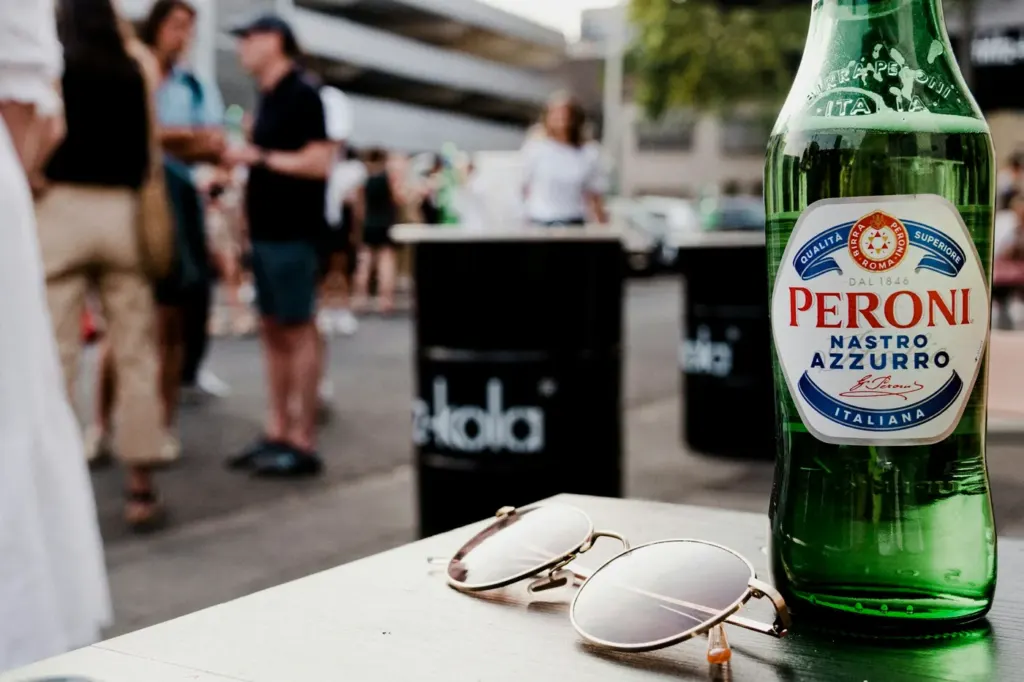
Almost everything people believe about skunked beer is wrong. It is not caused by warmth, it is not caused by the beer being old, and it has nothing to do with the beer having been chilled and then allowed to warm up again. It is a light reaction, it happens in minutes, and the bottle is often the reason.
The short answer
Ultraviolet and blue light break down the hop compounds that make beer bitter. The fragments recombine with sulphur already present in the beer to form 3-methyl-2-butene-1-thiol — a molecule almost identical to one of the compounds in skunk spray, and detectable by humans at a few parts per trillion. Brown glass blocks most of the light that does this. Green and clear glass barely block any.
What is actually happening
Bitterness in beer comes from iso-alpha acids, produced when hops are boiled. They are also, unfortunately, light-sensitive.
When UV or blue light hits them, the molecule splits. One of the fragments is a highly reactive radical, and it readily finds a sulphur-containing compound — beer has plenty, courtesy of the yeast — and bonds with it. The product is that thiol, and the human nose is extraordinarily good at detecting it, which is not a coincidence: being able to smell skunk at vanishingly small concentrations has obvious survival value.
Two things follow from the mechanism. First, it is fast — direct sunlight can do measurable damage to a clear bottle in under a minute. Second, it only affects hopped beer. A beer brewed without hops cannot skunk, because there are no iso-alpha acids to break.
Why the bottle colour matters so much
Glass filters light selectively, and the wavelengths that cause the reaction sit at the blue and ultraviolet end.
- Brown glass absorbs most light below about 500 nanometres, which covers the damaging range. It is the best glass option by a wide margin.
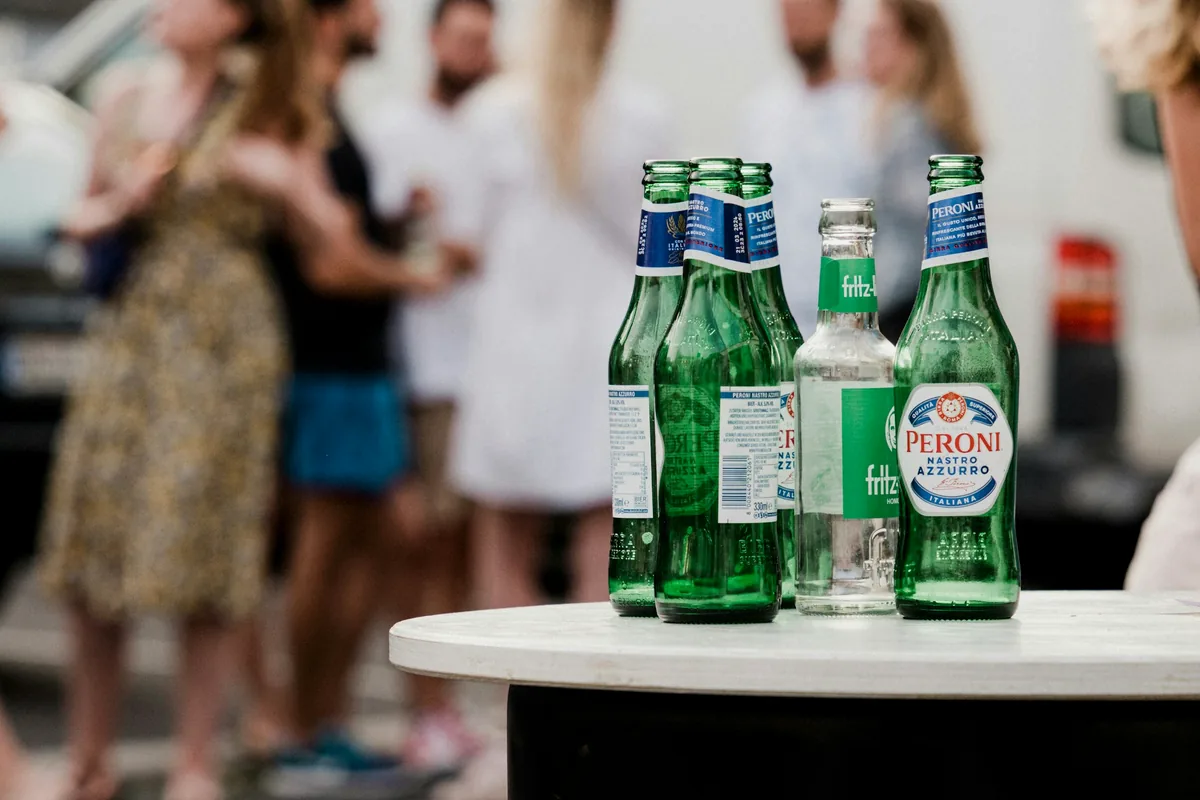
- Green glass blocks a much narrower band and lets a great deal of blue light through. It is close to no protection at all.
- Clear glass offers none.
Which raises the obvious question: why does anyone use green? Partly history — a wartime shortage of brown glass in Europe pushed several brewers to green, and by the time supply recovered the green bottle had become the brand. Partly marketing, because a green or clear bottle looks premium and shows the beer. And partly because some of those brands now use hop extracts that have been chemically modified so they cannot form the thiol at all, which lets them keep the bottle and lose the problem.
Where beer actually gets skunked
Not usually in the brewery, and not usually in your fridge. The damage is done in the gaps:
- The shop shelf, especially under fluorescent light or in a window display.
- The glass-fronted cooler, lit from inside, which is a light box with beer in it.
- The patio table, in direct sun, which is the fastest of all.
- The back seat of a car on the drive home.
A cardboard case is genuinely protective, which is a good argument for buying beer in its box rather than as loose bottles from a lit display.
What it is not
The most stubborn beer myth in circulation is that letting cold beer warm up and then re-chilling it “skunks” it. It does not. Temperature cycling is not good for beer — heat accelerates staling, which produces cardboard and sherry notes — but it does not produce the skunk. Only light does that.
Nor is skunking the same as a beer being old. Stale beer tastes of wet paper, toffee or sherry. Skunked beer smells of skunk. They are different faults with different causes, and a beer can have both.
Telling it apart from the other faults
Skunking gets blamed for a lot of beer that is wrong in some other way. Four faults account for most of it, and they are distinguishable:
- Skunked — smells of skunk, burnt rubber or cannabis. Caused by light. Instant and irreversible.
- Stale — wet cardboard, paper, sometimes sherry or toffee. Caused by oxygen and time, accelerated by heat.
- Infected — sour, vinegary or medicinal in a beer not meant to be. Caused by wild bacteria, often from a dirty draught line.
- Diacetyl — butter, butterscotch or a slick mouthfeel. A fermentation or line-cleanliness fault, not a light one.
If several different beers at the same bar share a fault, the problem is the bar. If one bottle from a six-pack is wrong and the rest are fine, the problem was that bottle’s trip through the light.
How to avoid it
- Buy brown glass or cans where you have the choice. Cans are perfect: they transmit no light at all.
- Buy from the back of the shelf, or from a case, rather than from the lit display.
- Store beer in the dark. A cupboard beats a countertop; a closed fridge beats a glass-doored one.
- Do not leave bottles in the sun, even briefly. This is the one that actually catches people out.
- Pour into a glass and drink it — light damage to a poured beer is not a practical concern over the few minutes it exists.
What that looked like on a real list
Meyboom’s archived lists are a decent illustration of the split. The bottled beers included Grolsch and Stella Artois, both sold in green glass, alongside a long run of Belgian ales in brown — the Rocheforts, the Westmalles, Duvel, Orval. Almost every strong Belgian bottle on the list came in brown glass, and almost every mass-market European lager came in green.
That is not an accident of taste. Brewers who expect their beer to be kept for months, and who use a great deal of hops in it, do not take chances with the glass. The archived bottle list and beer list are both still on the site.
Frequently asked questions
Does warm beer skunk?
No. Warmth stales beer, producing papery and sherry-like flavours, but the skunk aroma is caused only by light.
Can canned beer skunk?
Not in the can — aluminium blocks all light. Once poured into a glass and left in the sun, it is as vulnerable as anything else.
Why does one famous green-bottled lager always smell like that?
Green glass plus a long, brightly lit distribution chain. Some brands in green glass now use light-stable hop extracts specifically to prevent it; others do not.
Is skunked beer safe to drink?
Yes. It is unpleasant, not harmful. The thiol is detectable far below any level that could do anything to you.
How quickly can it happen?
In direct sunlight through clear glass, in under a minute. Through green glass, a few minutes. Through brown glass, hours to days of steady exposure.
The short version
Light, not heat. Hops, not age. Brown glass and cans protect beer; green and clear glass mostly do not. Keep it in the dark, and never leave a bottle on a sunny table.
Related: draught vs bottled beer and what ABV and IBU actually tell you.