
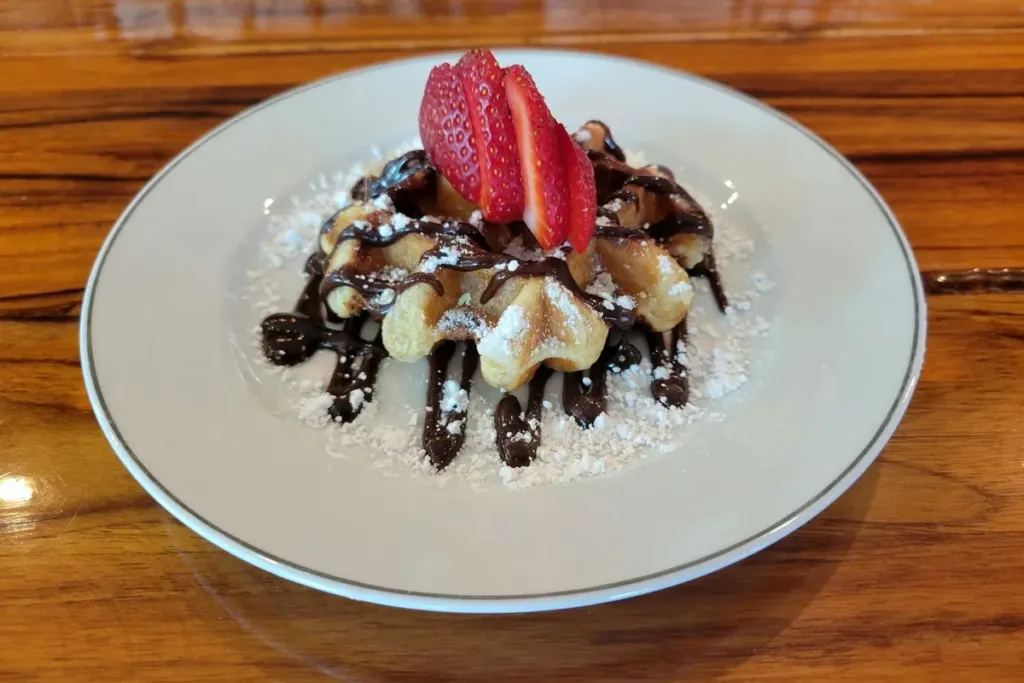
Belgium has two national waffles and they have almost nothing in common. One is a dessert eaten with a knife and fork. The other is a chewy sweet brick you eat with your hands, walking. Most menus outside Belgium call both of them a Belgian waffle, which helps nobody.
The short answer
A Liege waffle is made from a stiff yeasted dough studded with pearl sugar, which melts and caramelises against the iron. It is dense, chewy, uneven in shape and sweet enough to eat plain.
A Brussels waffle is made from a thin, light batter, often leavened to be airy. It is rectangular, crisp, deeply pocketed and quite plain on its own, so it is served with toppings and eaten at a table.
Dough versus batter
This is the difference everything else follows from.
The Liege waffle starts as a dough closer to brioche — enriched, yeasted, stiff enough to handle. Nuggets of pearl sugar are worked in at the end. Pearl sugar is compressed beet sugar that does not fully dissolve, so it survives mixing and then caramelises where it touches the hot iron. That is what gives a Liege waffle its lacquered, slightly crunchy patches and its uneven edges.
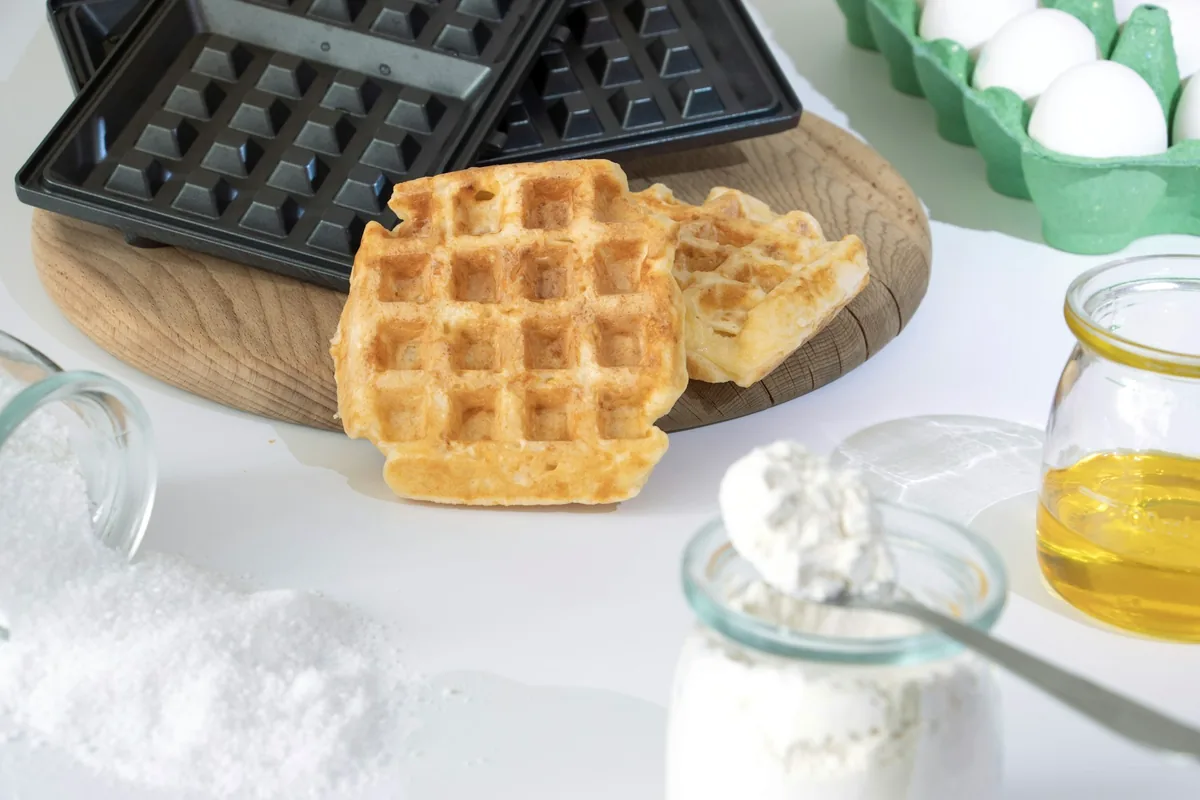
The Brussels waffle starts as a pourable batter, sometimes lightened with beaten egg white or yeast. It fills the iron completely, which is why it comes out rectangular with clean edges and deep square pockets. It is crisp rather than chewy, and much less sweet.
Side by side
| Liege waffle | Brussels waffle | |
|---|---|---|
| Base | Stiff yeasted dough, close to brioche | Thin pourable batter |
| Sugar | Pearl sugar worked into the dough | Dusted on afterwards, if at all |
| Shape | Oval with irregular edges | Rectangular with clean edges |
| Texture | Dense and chewy, caramelised outside | Light and crisp, deep pockets |
| Sweetness | Sweet enough to eat plain | Close to neutral |
| How it is eaten | In the hand, walking | At a table, knife and fork |
| Keeps well | Yes | No — soft within minutes |
So what is an American Belgian waffle?
A third thing, and the reason for most of the confusion.
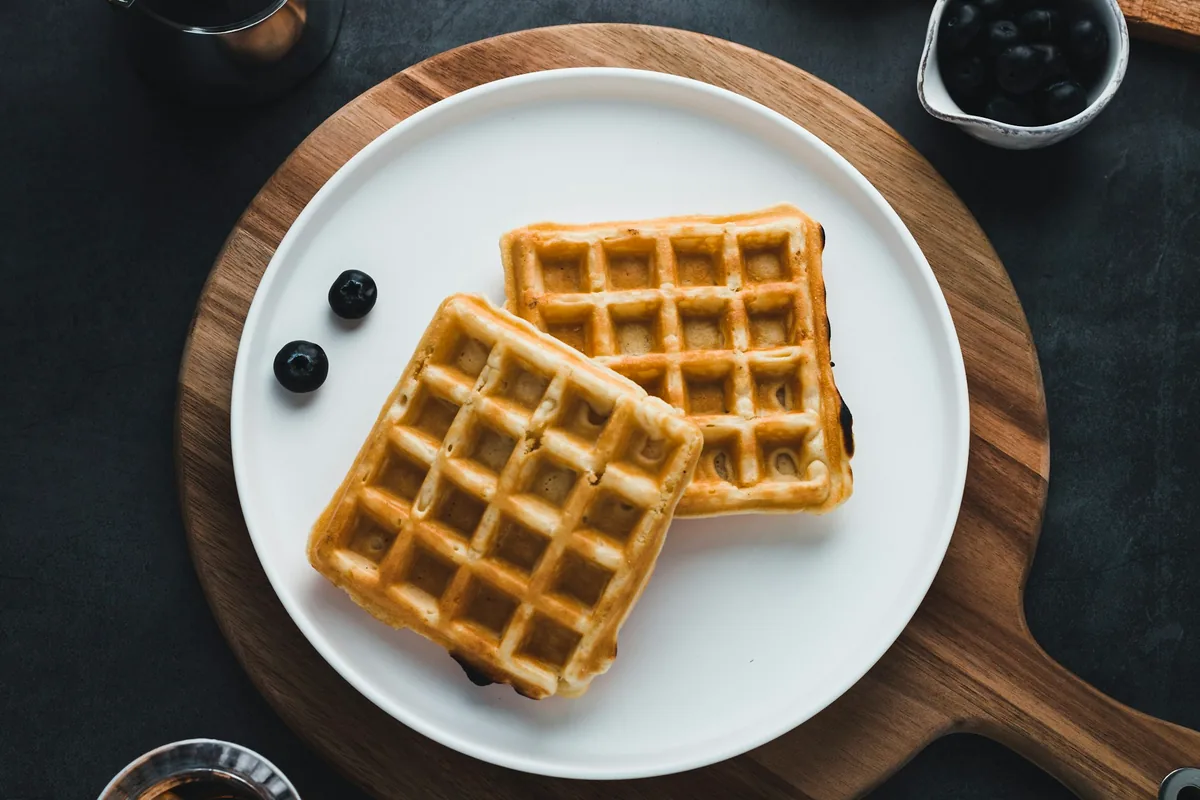
The waffle that Americans call Belgian is a descendant of the Brussels waffle, introduced to a wide US audience at the 1964 New York World’s Fair. It kept the deep pockets and the rectangular shape but became thicker, softer and more cake-like, leavened with baking powder rather than yeast, and it moved to the breakfast table with syrup.
It is a perfectly good thing. It is just not what either Belgian waffle is, and it is why visitors to Belgium are often surprised by both.
Belgium’s own federal information service draws the Liege–Brussels distinction plainly, which gives some idea of how tired Belgians are of the conflation.
Which one turns up on a menu outside Belgium?
Usually the Liege, for practical reasons. It holds its texture for far longer, travels better, and does not have to be served the second it leaves the iron. A Brussels waffle goes soft within minutes, which is why it is mostly made to order in a cafe.
Meyboom Brasserie served the Liege — made with pearl sugar, offered with a choice of two toppings from a list that ran through whipped cream, Dutch chocolate sauce, maple syrup, Nutella, speculoos crumbs, toasted almonds, strawberries and blueberries. It appeared on both the food menu and the brunch menu, which is the Belgian habit: a waffle is not a breakfast item, it is an any-time item.
Why pearl sugar cannot be substituted
This is the question that comes up most from people trying to make a Liege waffle at home, and the answer is unusually absolute: nothing else works.
- Granulated sugar dissolves into the dough during mixing and proving. You get a sweeter dough and no caramel pockets at all.
- Sugar cubes, crushed get closer, but they shatter into dust and fragments rather than holding as nuggets, so the melt is uneven.
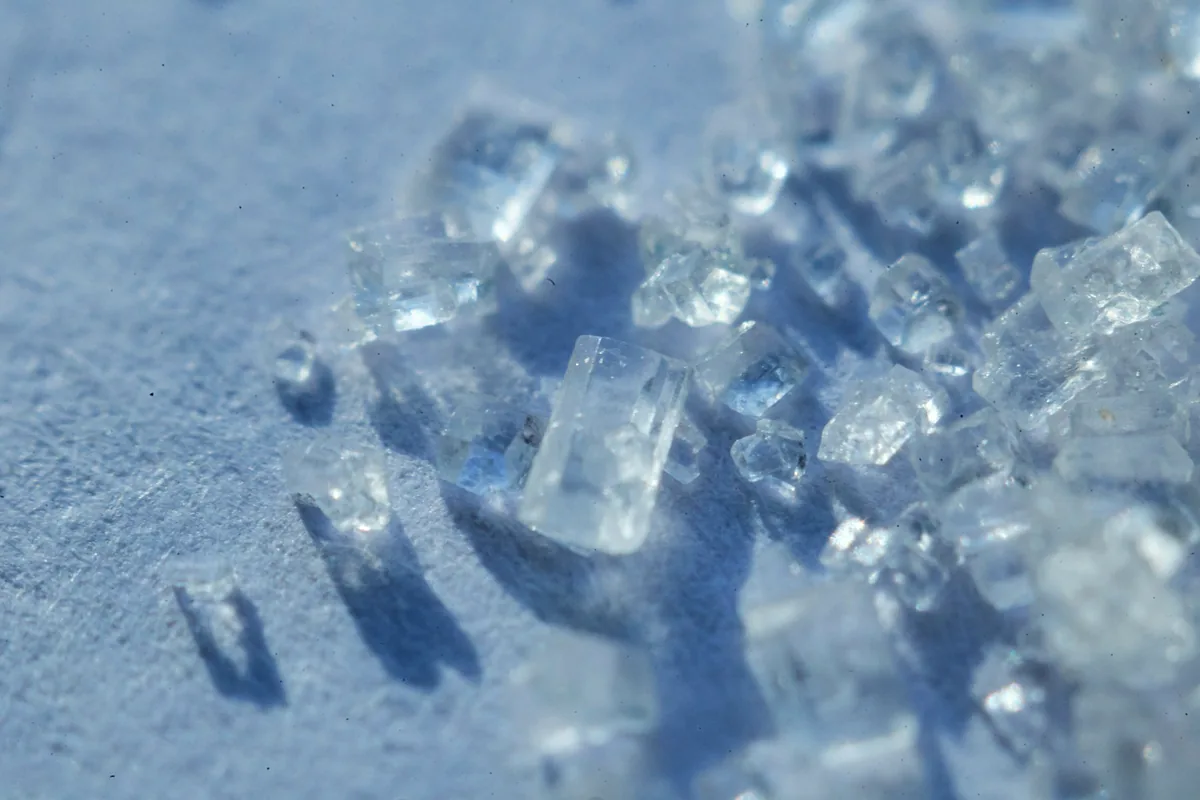
- Swedish or Scandinavian pearl sugar — sold for topping buns — is a different product. It is designed not to melt, so it stays on the surface as white specks instead of turning to caramel.
Belgian pearl sugar is compressed beet sugar in irregular lumps, formulated to survive mixing and then melt at frying temperature. It is the one ingredient in the recipe with no workaround.
A note on toppings
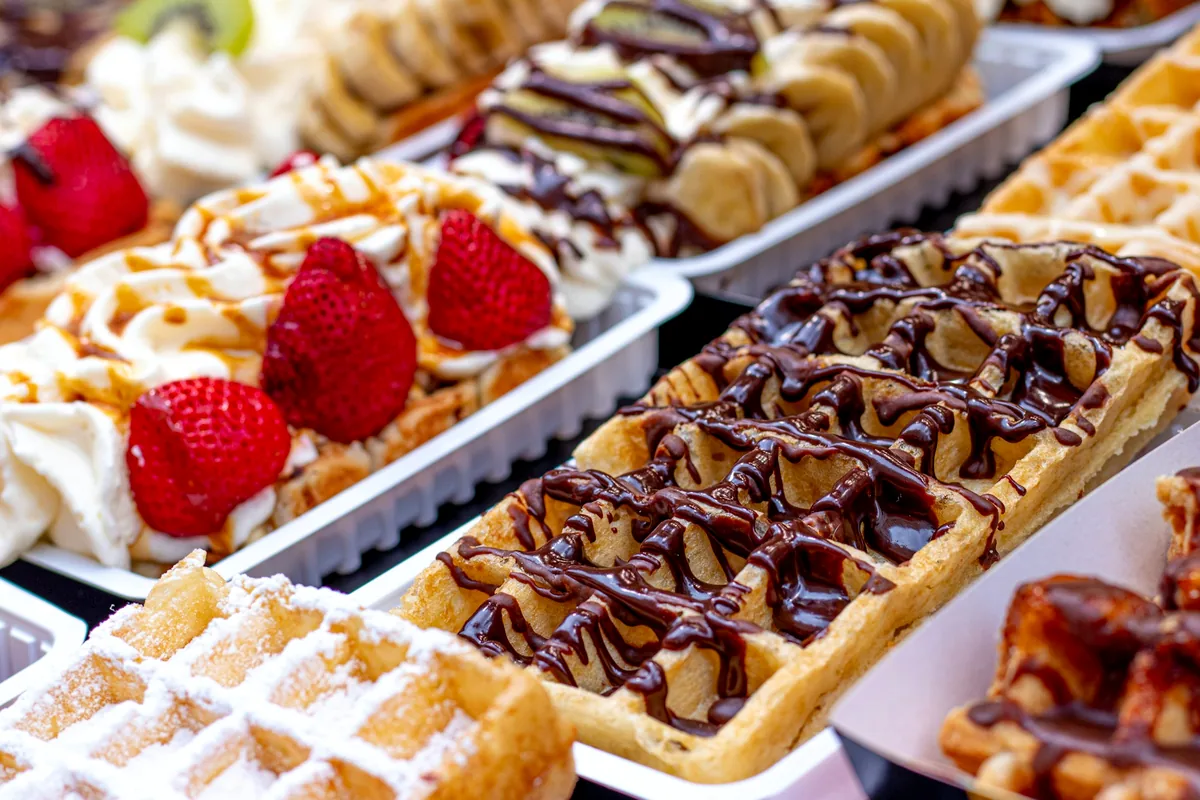
Outside Belgium both waffles arrive loaded. Inside Belgium, the convention is closer to the opposite: a Liege waffle bought from a stand is usually handed over plain, because the caramelised sugar is the flavour and anything on top competes with it. The elaborate towers of cream, chocolate and fruit belong mostly to the Brussels waffle and to tourist-facing stands in the city centre.
Neither is wrong. But if you have only ever had a Liege waffle under a pile of toppings, you have not really tasted one.
How to eat each one
- Liege: in your hand, warm, ideally with nothing on it the first time. The caramelised sugar is the point, and toppings bury it.
- Brussels: at a table, with a knife and fork, with something on it. Icing sugar at minimum; cream, fruit or chocolate more usually. It is deliberately plain on its own.
Frequently asked questions
Which Belgian waffle is sweeter?
The Liege, by a wide margin, because the pearl sugar is inside the dough rather than dusted on top. A Brussels waffle is close to neutral and relies on its toppings.
What is pearl sugar?
Compressed beet sugar in irregular nuggets that resist melting. Worked into a Liege dough, it holds its shape through mixing and then caramelises against the iron. Ordinary granulated sugar dissolves and will not do the same job.
Are Belgian waffles eaten for breakfast in Belgium?
Not typically. They are an afternoon or street snack, or a dessert. The breakfast association is largely American.
Why is my Liege waffle not chewy?
Almost always because it was made from batter rather than dough. Without a stiff yeasted dough and real pearl sugar it becomes a sweet Brussels waffle, which is a different thing.
Which came first?
The Brussels waffle is the older of the two in its recognisable modern form, though both descend from a long European tradition of cooking batter between hot irons.
Worth remembering
Dough and pearl sugar means Liege. Batter and a rectangle means Brussels. Thick, soft and served with syrup at breakfast means you are in America.
Waffles are one of the fixtures of the format described in what is a Belgian brasserie, and the other one is on the plate next to it — see why Belgian fries are different. The Liege as Meyboom served it is on the archived brunch menu.