
Belgian endive is the only vegetable most people eat that has to be grown twice, and the second time it has to be grown somewhere it cannot see. Let any light reach it and it turns green, opens out and becomes too bitter to sell. The pale, tight, torpedo-shaped head in the shop is the product of deliberate, total darkness.
It is also a Belgian speciality with a very good origin story, which is unfortunately a legend.
The short answer
Belgian endive — witloof in Dutch, chicon in French — is chicory, Cichorium intybus. A root is grown in a field in the first season, lifted, and then forced to sprout a second time indoors in complete darkness. Without light the new leaves cannot make chlorophyll, so they stay white and yellow, stay furled into a tight head, and stay mild rather than aggressively bitter.
Two crops from one plant
The first stage is ordinary agriculture. Chicory is sown in spring and grown through the summer, and what the grower wants is not the leaves but a fat taproot, something like a parsnip. In autumn the tops are cut off and the roots are lifted and put into cold storage.
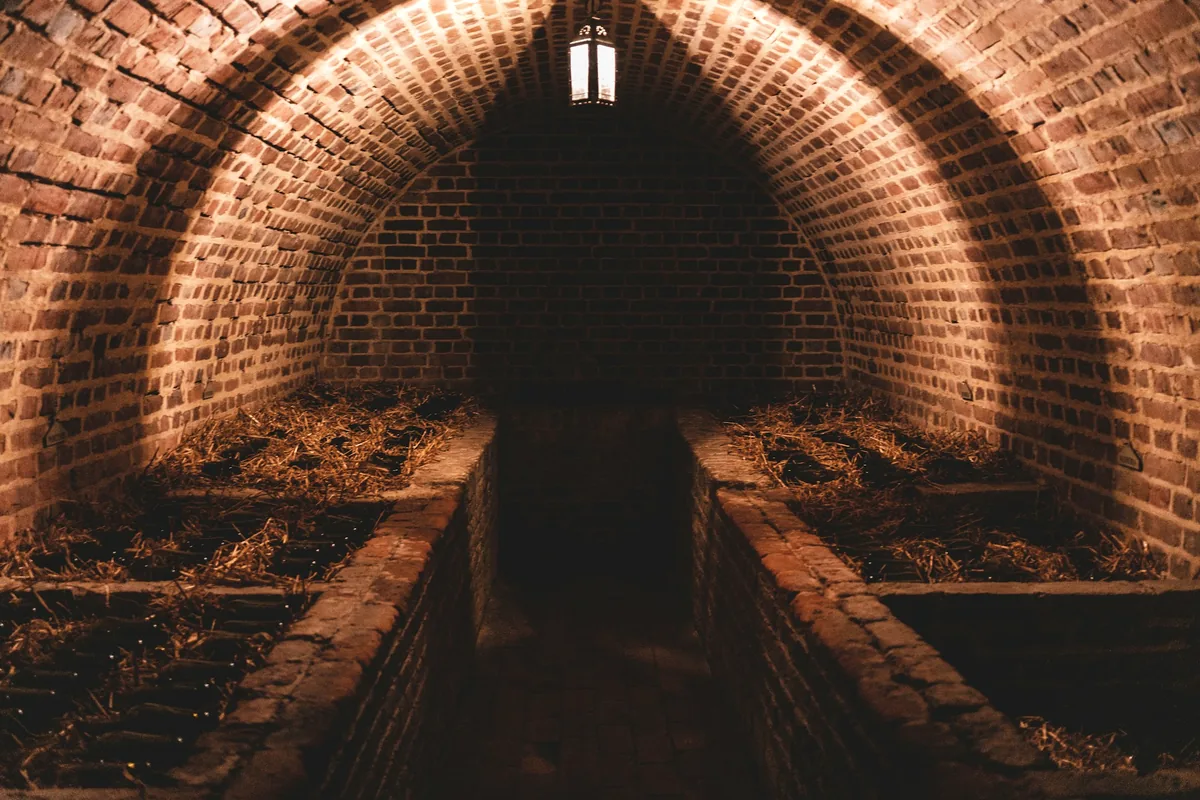
The second stage is the unusual one, and it is called forcing. The stored roots are brought into a warm, humid, completely dark room and made to sprout again. They have a full season’s energy packed into them and no light to grow towards, so they push out a compact bud of leaves using the root’s own reserves. That bud is the vegetable. Traditionally the roots were covered with a layer of soil and topped with curved metal plates to keep the light out; the modern version is a windowless shed.
This process — growing a plant in darkness so it stays pale and tender — is called etiolation, and it is the same principle behind forced rhubarb and blanched celery. In witloof it does two jobs at once. It keeps the leaves white, and it keeps them sweet, because the bitter compounds chicory is otherwise full of develop much more strongly in the light.

The same plant, three ways
Chicory is one species doing several unrelated jobs on a menu, which is a common source of confusion.
| Name | What it is | How it is grown |
|---|---|---|
| Witloof / chicon / Belgian endive | A pale, tight, mild leaf head | Root forced a second time in total darkness |
| Radicchio / red chicory | A red and white bitter leaf | Grown normally, in daylight |
| Chicory root | Roasted and ground as a coffee substitute | Grown for the root, never forced |
The English name is the worst part of this. In English, “endive” and “chicory” are used almost interchangeably and often for the wrong plant, and American and British usage disagree with each other. French makes the opposite mistake in the opposite direction. If you want to be unambiguous, witloof and chicon both mean exactly one thing.

The discovery story, and why it is a legend
The version you will read almost everywhere in English goes like this. In 1830, during the upheaval of Belgian independence, a farmer named Jan Lammers in Schaerbeek, on the edge of Brussels, hid his chicory roots in his cellar under a covering of soil and went off to the fighting. He came back months later to find the roots had sprouted pale, tender white leaves. He tasted them. Belgian endive was born.
It is a lovely story and Belgian and Flemish sources say there is very little truth in it.
The better-supported account credits Frans Bresiers — his name also appears as Brezier, Breziers and François — the head gardener at the Brussels Botanical Garden. The most specific version places the accident in the winter of 1834 at the Botanique in Schaerbeek, where experimental chicory roots left on a heap of soil were found months later carrying white shoots. What matters is what Bresiers did next: he worked out that the plant wanted darkness, warmth and humidity, and turned an accident into a repeatable method. An accident nobody systematises is not a discovery.
The honest position is that the credit is contested and both men are tied to the same corner of Schaerbeek. It is entirely possible that growers there were already doing something like this, that the folk memory preserved in the Lammers story is real, and that the name attached to it is wrong. What is not in doubt is that the technique came out of Schaerbeek in the 1830s and was commercialised from there.
The dates are a mess even in careful sources. 1830, 1834, 1846, “the 1850s”, 1867 for the first sale under the name witloof on the Brussels market, and 1873 for its formal presentation at a horticultural exhibition all circulate. Treat any single confident date with suspicion.
Soil-grown and water-grown
There are now two ways to force witloof and they are not equivalent.
Grondwitloof is the traditional method: roots forced in soil, in the dark, over several weeks. It is slow, seasonal and labour-intensive.
Hydrowitloof arrived in the 1970s. The roots are forced hydroponically in climate-controlled warehouses, in trays of nutrient solution rather than soil. It is faster, works all year round, and produces a more uniform and cheaper head. Most witloof on sale is now this.
Soil-grown endive from a defined zone around Brussels, using growers’ own seed, holds EU Protected Geographical Indication status as Brussels grondwitloof, granted in 2008. In 2021 Brussels also added the chicon to its inventory of intangible cultural heritage.
Both of those are the sort of protection a thing gets when it is in trouble. The scale of the decline is worth stating plainly: in 1975 witloof accounted for nearly a quarter of all vegetable growing in Belgium, across some 9,300 hectares and around 4,800 farms. By 2016 there were 264 growers left on about 1,434 hectares. Growers of the soil-forced version have warned it may not survive another twenty years.
On a Belgian menu
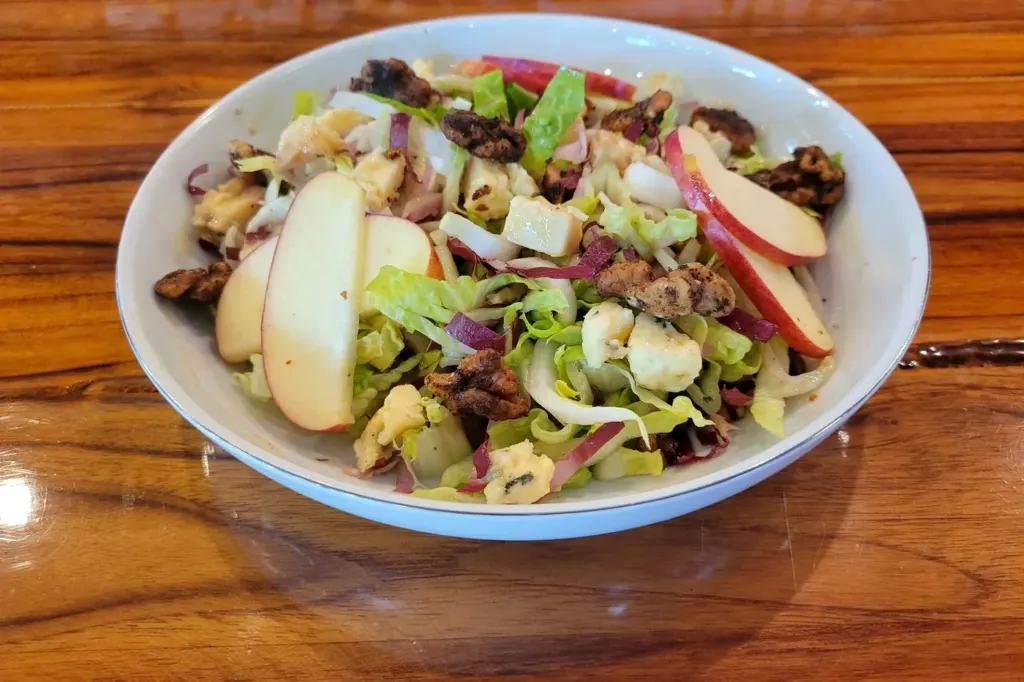
Witloof turns up three ways. Raw and sliced into salads, where the bitterness is the point and it is usually set against something sweet and something rich — apple and blue cheese is the classic pairing, and it is what Meyboom’s archived dinner menu did with it, chopping endive with apple slices, toasted walnuts and blue cheese. Braised, where it goes soft and caramelises. And in chicon au gratin, Belgium’s great domestic dish, where the whole heads are wrapped in ham, covered in béchamel and cheese and baked.
Buying it, the thing to look for is the tip. Pale yellow-green tips are correct. Dark green ones mean it has seen light, and it will be noticeably more bitter.
Frequently asked questions
Why is Belgian endive white?
Because it is grown in complete darkness. Chlorophyll only forms in light, so leaves grown without it stay white and pale yellow.
Is Belgian endive the same as chicory?
It is a form of chicory. The same species also gives radicchio and the roots used as a coffee substitute. Witloof is the version forced in the dark for its pale head.
Why is it called Belgian endive?
Because it was developed in Belgium, around Schaerbeek in Brussels, in the 1830s, and Belgium remains the country most identified with it. In Belgium itself nobody calls it that: it is witloof or chicon.
Was it really discovered by accident?
Probably something like it, but the widely repeated Jan Lammers version is a legend. Belgian sources credit Frans Bresiers of the Brussels Botanical Garden, who identified what the plant needed and made the method repeatable.
Why is mine so bitter?
Most likely it has been exposed to light, which you can usually see in green-tinged leaf tips. Bitterness also concentrates in the solid core at the base, which is commonly cut out.
The short version
Belgian endive is chicory grown twice: once in a field for the root, once in the dark for the head. Darkness is not a preference, it is the entire production method, and it is what keeps the vegetable white and mild. It came out of Schaerbeek in the 1830s, the famous farmer-and-cellar story is folklore, and the soil-grown original now carries EU protection and is disappearing anyway.
Related: what a Belgian brasserie serves and why Belgian fries are different.