Most people know hops make beer bitter. Fewer know that bitterness is the least interesting of the three things hops do, or that the same plant which makes a beer taste of grapefruit is also the reason it has not spoiled.
The short answer
Hops do three jobs: they bitter the beer, they perfume it, and they preserve it. Which job you get depends almost entirely on when the hops go in — early for bitterness, late for aroma — because the two useful groups of compounds inside a hop cone behave in opposite ways when heated.
What a hop is
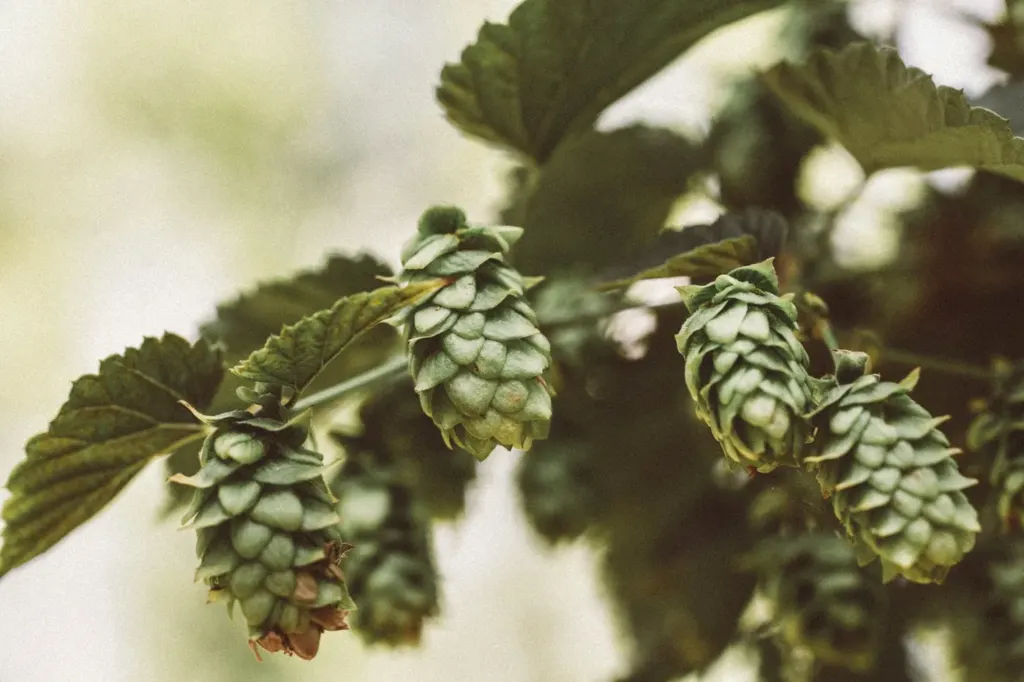
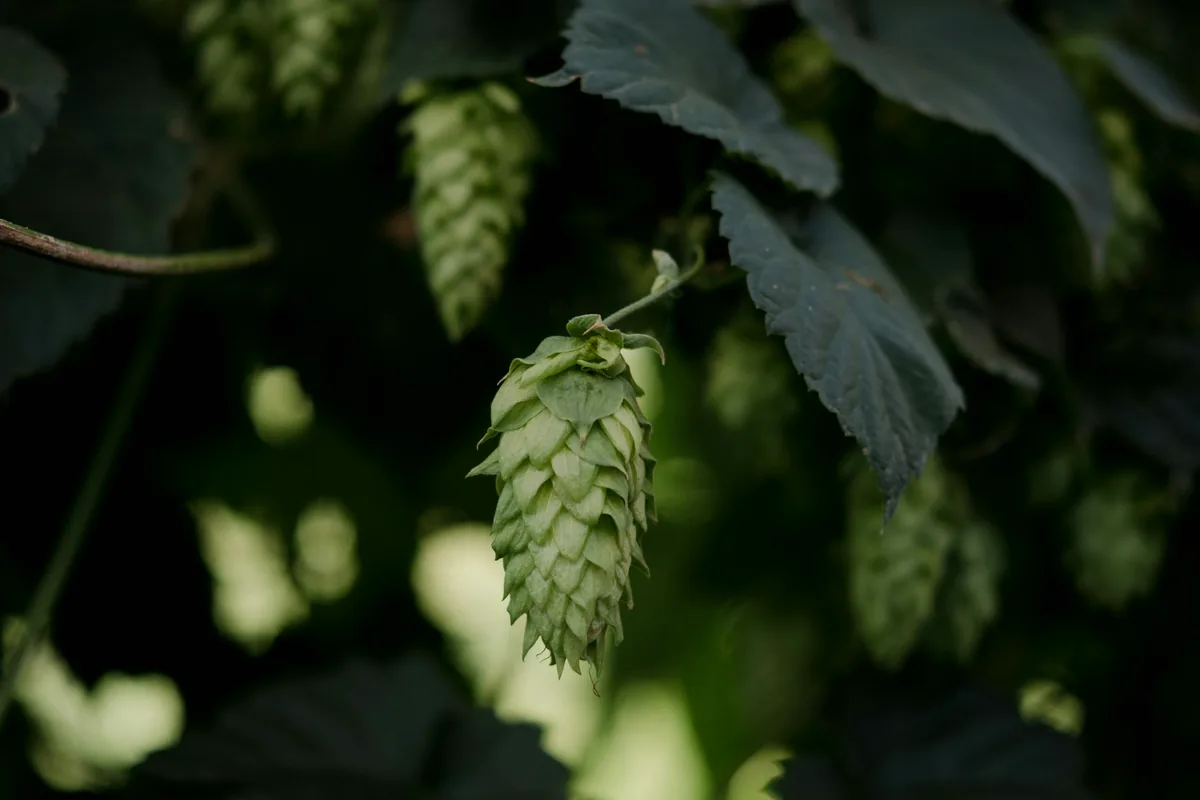
The hop is the flower of Humulus lupulus, a climbing plant related to cannabis. It grows as a bine rather than a vine — it climbs by winding its own stem round a support instead of gripping with tendrils — and it is grown up wires several metres tall.
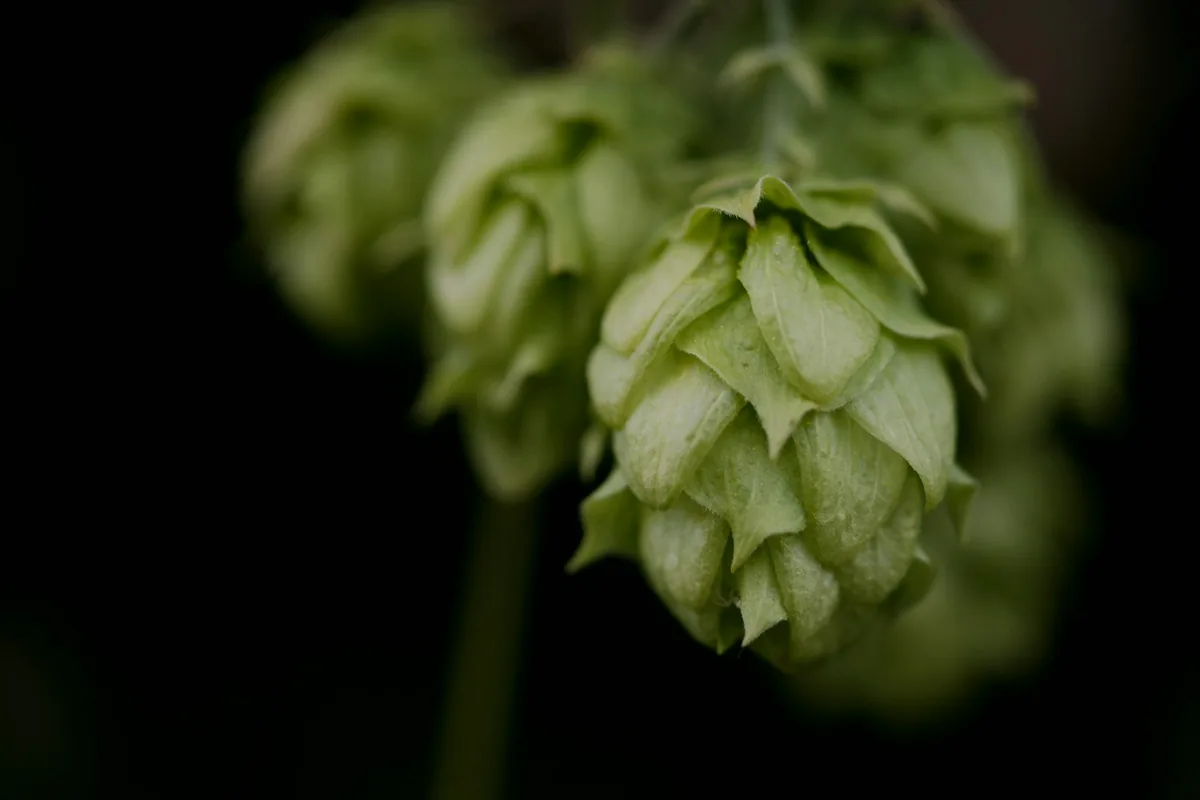
Inside the cone, at the base of each papery bract, sits a cluster of sticky yellow glands called lupulin. That resin is the whole point of the plant, and it carries two families of compounds that matter:
- Alpha acids — bitter, and not water-soluble until heat converts them.
- Essential oils — aromatic, and highly volatile.
Job one: bitterness
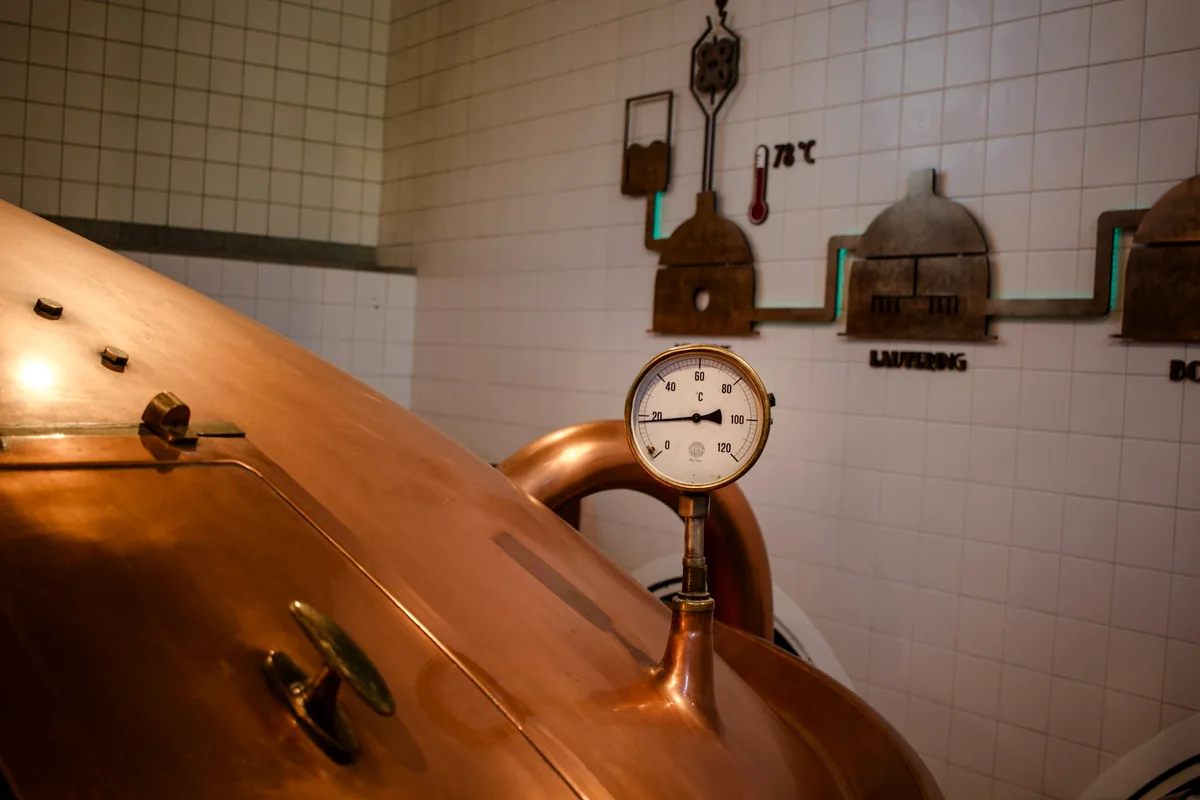
Alpha acids in a raw hop are barely soluble and barely bitter. Boiling changes them: heat rearranges them into iso-alpha acids, which dissolve readily and are intensely bitter. Brewers call this isomerisation, and it is slow — a full sixty to ninety minutes of boiling to convert a useful proportion.
So bittering hops go in at the start of the boil and stay there. It follows that a beer’s bitterness is a function of how much alpha acid went in and how long it boiled, which is what an IBU figure is measuring. We cover that number, and its limits, in what ABV and IBU actually tell you.
Bitterness is not there for its own sake. Malt is sweet, and without something to balance it a beer would be cloying. Bitterness is structural.
Job two: aroma
The essential oils do the opposite. They are volatile, which means a long boil drives them off entirely — everything that smells of citrus, pine, mango, grass or flowers is gone within minutes of hitting boiling wort.
Aroma hops therefore go in late: at the end of the boil, during the whirlpool as the wort cools, or after fermentation altogether. That last one is dry hopping, and because there is no heat at all it preserves the oils almost completely while adding essentially no bitterness. It is why a modern IPA can smell overwhelmingly of fruit without tasting punishingly bitter.
This is also why hop aroma is the first thing to disappear from a beer as it ages, and why nothing hoppy should be cellared. That argument is set out in which beers are actually worth cellaring.
Job three: preservation
The oldest job, and the reason hops won. Iso-alpha acids are antibacterial — they inhibit the Gram-positive bacteria that would otherwise sour beer — and they were being used for that long before anyone thought of bitterness as a flavour to enjoy.
Before hops, brewers used mixed herbs, and beer did not travel or keep. Hopped beer keeps and travels, and the whole idea of beer as a commodity rather than a local perishable follows from that single property.
There is a well-known side effect: those same iso-alpha acids are what break down under light to produce the skunk aroma. The compound that protects beer from bacteria is the compound that ruins it in a clear bottle — see why beer skunks.
Which hops, and why it matters
Varieties fall roughly into two camps, and the split maps onto the two brewing traditions people argue about.
Noble and European hops — Saaz, Hallertau, Tettnang, Spalt, and the Goldings — are low in alpha acid and subtle in aroma: herbal, floral, faintly spicy, sometimes grassy. They are what centuries of European brewing was built on, and they are what most Belgian brewers still use. Styrian Golding and East Kent Golding turn up constantly in Belgian recipes.
New-world hops — Cascade, Citra, Simcoe, Mosaic and the rest — are high in alpha acid and loud: grapefruit, passionfruit, pine, resin. They are the reason American craft beer smells the way it does, and they were largely bred for exactly that.
A brewer choosing Saaz over Citra is not being conservative for its own sake. Loud hops and expressive Belgian yeast fight each other, and one of them has to lose.
Why Belgian beer is hopped so lightly
This is where Belgium diverges sharply from American craft brewing, and it explains a lot about how a Belgian list reads.
In Belgian brewing the interest comes from the yeast. Warm fermentation with expressive strains produces the pepper, clove, banana and orchard-fruit character that defines the styles, and a heavy hop load would simply bury it. So hops are used for balance — enough bitterness to keep the malt and the candi sugar from turning syrupy — and then left alone.
The numbers make the point. On Meyboom’s archived beer list, which prints an IBU figure for every draught and bottle, the whole range runs from 7 to 40 IBU. A Westmalle Tripel at 9.5% sits at 40; a St. Bernardus Wit at 15; a Kronenbourg Blanc at 7. For comparison, a routine American IPA is 60 to 70, and plenty go past 100.
A Belgian beer at 40 IBU is at the top of its tradition. That is not restraint for its own sake — it is a decision about what the drinker is supposed to notice.
Frequently asked questions
Do hops make beer bitter or aromatic?
Both, but not at the same time. Early additions give bitterness and lose aroma; late additions and dry hopping give aroma and add almost no bitterness.
What does dry hopping mean?
Adding hops after the boil, usually during or after fermentation, with no heat involved. It extracts aroma oils without isomerising alpha acids, so the beer smells strongly of hops without becoming more bitter.
Are hops a preservative?
Yes. Iso-alpha acids inhibit many beer-spoiling bacteria, which is historically why hops replaced other bittering herbs.
Is a hoppy beer the same as a bitter beer?
No, and conflating them is the commonest mistake here. A heavily dry-hopped beer can smell intensely of hops and be only moderately bitter. Bitterness is one hop contribution among three.
Why do Belgian beers have such low IBU figures?
Because the flavour is meant to come from the yeast and from candi sugar rather than from hops. Bitterness is used to balance sweetness, not to lead.
The short version
Early hops bitter, late hops perfume, and all hops preserve. Bitterness needs a long boil; aroma is destroyed by one. Belgium uses hops for balance and lets the yeast do the talking, which is why a strong Belgian ale reads as fruity and spicy rather than bitter.
Related: why Belgian beer is so strong and why beer has a head.